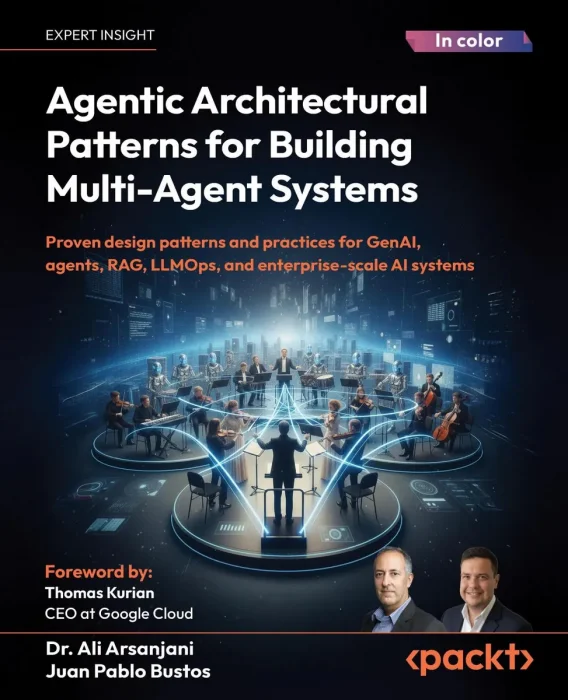
Agentic Architectural Patterns for Building Multi-Agent Systems: Proven design patterns and practices for GenAI, agents, RAG, LLMOps, and enterprise-s
Published January 23rd, 2026
ISBN 180602957X
Language English
Pages 574
Formats True PDF
Add favorites
Transform GenAI experiments into production-ready intelligent agents with scalable AI systems, architectural patterns, frameworks, and responsible AI and governance best practices
Key Features
• Build robust single and multi-agent GenAI systems for enterprise use
• Understand the GenAI and Agentic AI maturity model and enterprise adoption roadmap
• Use prompt engineering and optimization, various styles of RAG, and LLMOps to enhance AI capability and performance
Book Description
Generative AI has moved beyond the hype, and enterprises now face the challenge of turning prototypes into scalable solutions. This book is your guide to building intelligent agents powered by LLMs.
Starting with a GenAI maturity model, you’ll learn how to assess your organization’s readiness and create a roadmap toward agentic AI adoption. You’ll master foundational topics such as model selection and LLM deployment, progressing to advanced methods such as RAG, fine-tuning, in-context learning, and LLMOps, especially in the context of agentic AI. You'll explore a rich library of agentic AI design patterns to address coordination, explainability, fault tolerance, and human-agent interaction. This book introduces a concrete, hierarchical multi-agent architecture where high-level orchestrator agents manage complex business workflows by delegating entire sub-processes to specialized agents. You’ll see how these agents collaborate and communicate using the Agent-to-Agent (A2A) protocol.
To ensure your systems are production-ready, we provide a practical framework for observability using life cycle callbacks, giving you the granular traceability needed for debugging, compliance, and cost management. Each pattern is backed by real-world scenarios and code examples using the open source Agent Development Kit (ADK).
What you will learn
• Apply design patterns to handle instruction drift, improve coordination, and build fault-tolerant AI systems
• Design systems with the three layers of the agentic stack: function calling, tool protocols (MCP), and A2A collaboration
• Develop responsible, ethical, and governable GenAI applications
• Use frameworks such as ADK, LangGraph, and CrewAI with code examples
• Master prompt engineering, LLMOps, and AgentOps best practices
• Build agentic systems using RAG, fine-tuning, and in-context learning
Who this book is for
This book is for AI developers, data scientists, and professionals eager to apply GenAI and agentic AI to solve business challenges. A basic grasp of data and software concepts is expected. The book offers a clear path for newcomers while providing advanced insights for individuals already experimenting with the technology. With real-world case studies, technical guides, and production-focused examples, the book supports a wide range of skill levels, from learning the foundations to building sophisticated, autonomous AI systems for enterprise use.
Key Features
• Build robust single and multi-agent GenAI systems for enterprise use
• Understand the GenAI and Agentic AI maturity model and enterprise adoption roadmap
• Use prompt engineering and optimization, various styles of RAG, and LLMOps to enhance AI capability and performance
Book Description
Generative AI has moved beyond the hype, and enterprises now face the challenge of turning prototypes into scalable solutions. This book is your guide to building intelligent agents powered by LLMs.
Starting with a GenAI maturity model, you’ll learn how to assess your organization’s readiness and create a roadmap toward agentic AI adoption. You’ll master foundational topics such as model selection and LLM deployment, progressing to advanced methods such as RAG, fine-tuning, in-context learning, and LLMOps, especially in the context of agentic AI. You'll explore a rich library of agentic AI design patterns to address coordination, explainability, fault tolerance, and human-agent interaction. This book introduces a concrete, hierarchical multi-agent architecture where high-level orchestrator agents manage complex business workflows by delegating entire sub-processes to specialized agents. You’ll see how these agents collaborate and communicate using the Agent-to-Agent (A2A) protocol.
To ensure your systems are production-ready, we provide a practical framework for observability using life cycle callbacks, giving you the granular traceability needed for debugging, compliance, and cost management. Each pattern is backed by real-world scenarios and code examples using the open source Agent Development Kit (ADK).
What you will learn
• Apply design patterns to handle instruction drift, improve coordination, and build fault-tolerant AI systems
• Design systems with the three layers of the agentic stack: function calling, tool protocols (MCP), and A2A collaboration
• Develop responsible, ethical, and governable GenAI applications
• Use frameworks such as ADK, LangGraph, and CrewAI with code examples
• Master prompt engineering, LLMOps, and AgentOps best practices
• Build agentic systems using RAG, fine-tuning, and in-context learning
Who this book is for
This book is for AI developers, data scientists, and professionals eager to apply GenAI and agentic AI to solve business challenges. A basic grasp of data and software concepts is expected. The book offers a clear path for newcomers while providing advanced insights for individuals already experimenting with the technology. With real-world case studies, technical guides, and production-focused examples, the book supports a wide range of skill levels, from learning the foundations to building sophisticated, autonomous AI systems for enterprise use.
Download Agentic Architectural Patterns for Building Multi-Agent Systems: Proven design patterns and practices for GenAI, agents, RAG, LLMOps, and enterprise-s
Similar books
Information
Users of Guests are not allowed to comment this publication.
Users of Guests are not allowed to comment this publication.